Off our Scopes

Things have been going very well for the past weeks, with progress on developing my 3D modeling, texture painting, and rigging skills going much faster than I ever anticipated. I am planning to keep focusing on improving my texturing and animating skills, developing an art style, and putting together a basic assets library for the time being. But as things are going now, I think there’s a good chance I might actually start moving on to learning game programming in Godot before next year.

As part of figuring out an appropriate, consistent, and practical art style, I’ve also been thinking again about the overall approach to storytelling, NPC interactions, and gameplay mechanics over the last weekend. These do have some real consequences on how the game world will need be constructed and what kind of expressions NPC models will need to be capable of. Working out game mechanics and a general style of level geometry first and then creating assets according to the needs that arise would probably be the smarter approach in most situations. But with how much I’m putting on my plate with all of this, I feel that mastering Blender first before moving on to Godot instead of doing both in parallel will be a lot more sustainable for me. It could mean that I might have do redo a good amount of assets as gameplay changes during development. But having at least a solid plan now for how players are intended to move through the game world and interact with it should help with reducing the amount of asset work that will have to be redone.

While researching 3D games from the mid 90s and recent indie games with a similar Raw 3D look as references for an Iridium Moons art style, I became aware of Compound Fracture, a game greatly inspired by Dino Crisis. But other than two trailers that look very nice and impressive, there really is very little information on that game. And as it turns out, the first trailer came out almost 5 years ago now. Is it actually going to come out one day? Hard to say, but by now it seems quite unlikely.

This had me check up on some other 90s styles scifi action games I’ve been very impressed by some time ago. Beta Decay had it’s first gameplay trailer 3 years ago. Selaco over 5 years ago. And Peripeteia 6 years ago. Peripetia had a playable build on Steam 1 year ago, and Selaco 2 years ago. And none of these games have a release date yet. That at least one of these four games will be finished eventually is probably almost certain. That two of them will get a full release is quite possible. But three? That seems doubtful. And all four? I really don’t think so. Grainy low-fidelity sci-fi games that exist on the intersection between action, ImSims, and Survival Horror have been a very popular idea that get people very excited for many years now. And getting something that looks really good and fun in trailers seems to be fairly easy. But the track record for such games actually getting finished has been terrible so far. And these are all from people who have way more qualifications and resources than I’ll ever going to have.

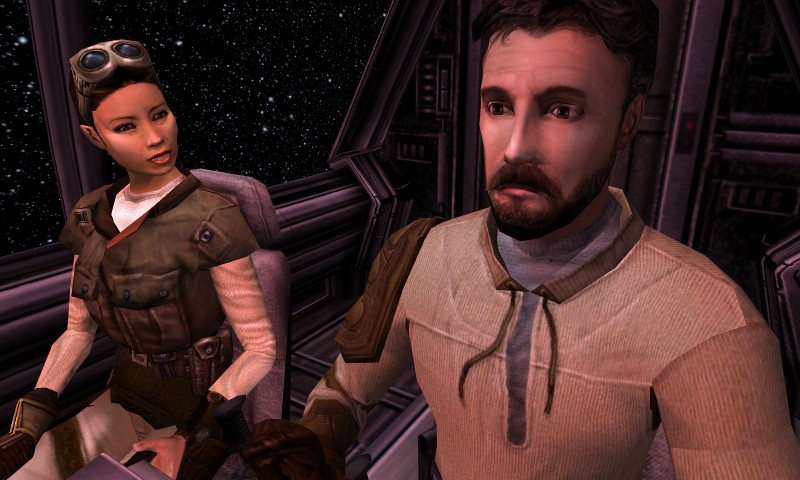
Back in the 90s and early 2000s, it wasn’t uncommon for popular games to have their follow up being released only one year later. Thief II, FreeSpace 2, Fallout 2, and Knights of the Old Republic II, all come to mind. Though many people at the time thought that it would have been much better if the games had been given another half or full year of development instead of rushing them out like that, it was possible to create beloved classics like that by essentially being just new levels for the same game with no meaningful changes to the engine or gameplay. Game development for mainstream, big budget titles has gotten longer ever since because developers wanted to appeal to new customers who weren’t already hooked by the gameplay of older similar games or the story of earlier games in a series by impressing with more advanced graphics, more spectacular game mechanics and physics, and more size. Simply making another campaign for a game that already exists was not really a commercial option for them, and still isn’t.

But for small indie developers that are targeting the retro-style market, I think this is exactly what the target audience is looking for. A bit more polish, a bit less jank, and taking some lessons from interface and controls evolution would be greatly welcome. But I think a game that has game mechanics that are basically identical to standards from 30 years ago is absolutely viable. Maybe add two or three small innovations to give the game an individual personality, but I think we really don’t need to have 2020s games with low-fidelity graphics as purely an aesthetic gimmick. Every developer and team is free to give it a shot, but I know it definitely is not an option for me. I made the decision to go with a Raw 3D aesthetic for Iridium Moons entirely because this is one way I can make a game look visually appealing while keeping the technical skill required to an absolute minimum.

The overall framework I settled on last week is to aim for a game that could pass as an asst flipped, knockoff-Star Wars themed, total conversion mod of Deus Ex with the sneaking and visibility mechanic of Thief. That’s it. Nothing more.

Actually less even, as I think character customization for different playstyles is better done by selecting your equipment loadout instead of assigning upgrade points to different skills.

Since I am much more interested in stealth and investigation gameplay and environment design and not really into the idea of writing big stories and complex characters, I think it can also be made very episodic. Instead of structuring the overall story like a 2000 page novel series, I see Iridium Moons more like 2 hour adventure movies with their own beginning and end that take place in the same universe and revolve around the same protagonists. This should allow me to get at least something out the door that players can play after 4 or 5 years of development. And if I still have more in me, I perhaps could continue with another episode over the next 2 or 3 years, and keep doing that until I get tired of it. Which seems much more feasible to me than aiming straight for a complete 40 hour game in 10 different locations that gets canceled after 12 years of development with no end in sight.

Border Dimensions for fixed resolution UI and Pixel Art

One of the annoying things with many older games that have been updated to run on newer screen resolutions is that the static image UI often gets tiny and unreadable or doesn’t cover the entire screen as it’s supposed to.

Fallout can do both!

Playing on the original resolution with the rest of the screen being filled black is usually my preferred solution. But sometimes the game doesn’t want to stretch out to make as much use of the screen as it could and be absolutely tiny, which can become a serious pain in the ass to fix. Scaling very low resolution 2D images by factors that aren’t whole numbers can also cause issues as image pixels have to be stretched unevenly to reach both sides of the screen. And even when all of that works out, playing with black bars on the sides of the game is fine for playing 30 year old games, but when making low-fidelity games now, we really should make an effort to deal with different screen sizes and dimensions.

My planned solution to this for Iridium Moon is to design all the UI in 640×360 resolution and upscale it by whole numbers to keep it from shrinking on the screen or get distorted pixels. This will allow the game to look identical in 720p (1280×720), 1080p (1920×1080), 2560×1440, 4K (3840×2160), and even 8K (7680×4320). Which going by the Steam user statistics covers the primarily display setting of 78% of players.

But that still leaves 22% of players for who this won’t display properly. It’s certainly one option to create alternative UI versions with different base resolutions, or to make a split UI that will stick to the top or bottom of the screen with variable space between them in the middle. A 640×400 resolution UI will upscale without distortion to 1280×800, 1920×1200, and 2560×1600, which covers another 8% of players.

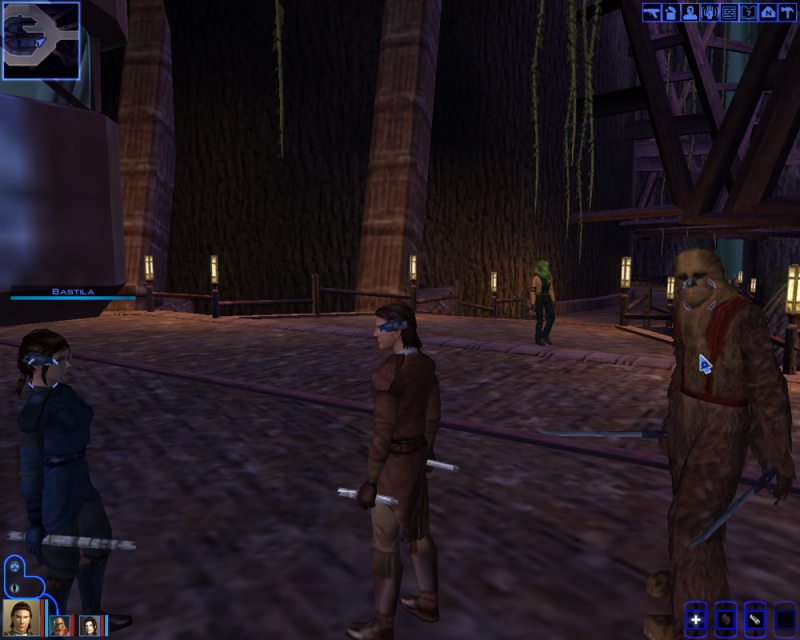
But the remaining 14% of players are spread out over a wide range of different aspect ratios, which each are being used only by few players. Making alternative UI versions to fit all these resolutions is not really practical, and they are going to have to accept playing with borders on the sides of their nonstandard sized screens. But they don’t have to be just black bars. There are mods for Knights of the Old Republic that extend the edges of menu screen to fill the entire screen.

KotOR Extended Menu Screen

But how much additional border do you need to fill out all screens when the main game UI has to remain a full number multiple of 640×360? Well, I’ve done the math, and it is this much.

Click to embiggen.

This image covers almost all the resolutions listed in the Steam user statistics and covers the screens of 96% of players. All of which fit into an additional border of 860×520 pixels.

Click to embiggen.

These three unusual resolutions are already very rare, being used by only 0.2%, 0.3%, and 0.5% of players on Steam, and so I wouldn’t worry too much about getting the outermost corners lavishly detailed. Very few people would ever see it.

For very detailed borders it could look a bit odd if some specific detail like a face or switch gets clipped by the screen edges. So it might be helpful to know where the clipping lines will be when placing such elements on the border. You can download the .xcf file for GIMP to use as a template when arranging the layout for such borders. The resolution shown in green, yellow, and light blue are not exactly the same aspect ratio, but the differences are mostly just a few pixels that would be very difficult to notice if they get clipped by the screen edges.

A visual style for Iridium Moons

Iridium Moons first started as an idea from the thought of “How would I redo Star Wars from scratch if it were up to me?” I’ve always only really been a fan of the movies and the Expanded Universe we had in the 90s, but even back then there was almost as much unfitting nonsense being added to its worlds as today. Which parts would I keep as they are? Which elements do I feel were missteps? And how do I think they could have been done better and more in line with what came before? Everything that the world of Iridium Moons has become over the last five years is really just elaboration on that original question.

So the overall design style and aesthetic of Iridium Moons in my imagination was always extremely heavily based on The Empire Strikes Back and Return of the Jedi. The way that Yoda’s Swamp, Cloud City, Jabba’s Palace, the Ewok Village, and the Imperial Outpost on Endor appear in the films is already incredible, but I think their aesthetic essence come through even stronger in Ralph McQuarrie’s concept art that those sets were based on. Even paintings for sets that never made it into the movies feel to me more like capturing the essence of Star Wars that matters to me than much of the later movies. But I am also just a really big fan of how he uses light to really bring those places to life.

Two other artist who’ve been around just as long but who I’ve become really aware of only fairly recently are Greg and Tim Hildebrand. Who not coincidentally were hired to make movie posters for Star Wars 50 years ago, and who did produce concept art for Shadows of the Empire in the early 90s, because their sense of aesthetic is quite similar with that of Ralph McQuarrie.

The first of these three I only found two weeks ago, and I think it’s become perhaps one of my favorite illustrations ever. Though I have no idea what that place or scene it’s showing is from. That third image from Shadows of the Empire might actually the the best and purest representation of the aesthetic sensibility of Iridium Moons that has been in my mind for some time now. The vibrant colors, the light and shadows, the stunning night sky, and the combination of retro-futuristic architecture with lush vegetation has everything I love.

I have had a fascination and infatuation with pine forests in the summer almost as long as I can imagine. It goes back to at least my first school trip to the Lüneburg Heath, a fairly big landscape between Hamburg, Hannover, and Braunschweig formed by the last two ice ages that is such barren, sandy soil that almost nothing grows there except for heather and pines. We did five half-day trips there over a week in first grade, and it’s been one of the most memorable experiences for me in my whole life. The light under the pines is something very special, and it probably also helped that the landscape can look a little bit like something from a dinosaur book from the 80s.

Seeing Return of the Jedi four years later and a big portion of it being set between and under those giant redwood trees cemented my fascination with these kinds of environment for all time. I also had some great vacations with my family in Southern Europe, where such pine forests are very common as well.

When I started resuming working with Blender last week and getting ready to make some first game environments, I had been thinking about what the general architectural elements are that make up the vague images for that have been floating in my mind for the last years. Particularly the Ralph McQuarrie designs of course, and then I had a sudden realization where else I’ve seen that general architectural aesthetic that I am envisioning as well. Ken Adam’s interior set designs for many of the James Bond movies.

If you’ve seen the Bond movies from the 60s and 70s a couple of times, you instantly know what the Bond Villain Lair style is. Ken Adam designed about half of them, and the other half very strongly follows the style he established in Goldfinger and You Only Live Twice. He also did the sets for Doctor Strangelove, which I think won’t come as any kind of surprise to anyone familiar with these movies. And considering the timeline and that both worked in movie production design, I think there’s a good chance that Ralph McQuarrie took considerable inspirations from Ken Adam’s style. He’s probably my favorite architect.

Both Adam’s James Bond designs and McQuarrie’s Star Wars design share a lot of very prominent features. The first that came to my mind immediately are the rows of support beams for the ceiling that protrude from the walls rather than being hidden inside them as it is usually done. Walls, and sometimes ceilings as well, are often slightly angled inwards, creating the appearance of a vaulted ceiling. Which often appears relatively low compared to the width of the room they cover. Lighting is added to these spaces often indirect, with lamps shining at the walls and reflecting into the space from there, and often directed to mostly illuminate the floor and lower walls, leaving the ceilings often quite dark. I don’t know if they are were I got that from, but I’ve always been lighting my homes in very similar ways. It just feels so much more cozy, with a hint of rustic. Which is a great match for the overall low-tech retro-futurism of Iridium Moons.

Ken Adam’s designs have clear influences from Brutalism, but his sets never had the appearance of actual raw concrete. It’s always either covered in warmer colored limestome or in the appearance of bare rock. Often with inexplicable fireplaces and fuzzy rugs, a lot of wood, and even lush plants. Which all helps with that hints of a rustic style in these hard stone environments. I think Brutalism is a very fascinating design style, but leaving the concrete completely bare always seems like too much and makes every space hostile and inhospitable. But add a bit of wood and some plants to it, and I think it can look really nice.

This is a very strong design aesthetic to use as a basis, but there’s also a couple of other things I want to add to that to give it my own personal touch.

I think lattice screens of any kind make every space instantly way more interesting and comforting. I think I got this idea from many of the artwork in the RPG Coriolis, where it’s a common element of the overall aesthetic. They also create shadows similar to pines (and planes, also a very nice tree), which I guess adds to my attraction for them. Though I do have some concerns that such visual elements might not work too well with low-resolution, unfiltered textures that make the Raw 3D look of the PlayStation so memorable. Covering already jagged textures with jagged see-through overlays might result in an excessively noisy image, and so this might not work out with the intended graphics style I am aiming for. But that’s something that will have to be seen later.

Another cool design element that is all over Coriolis is having decorative trims on the edges of fabrics. Which is something that I later noticed was also used by Ralph McQuarries design for the architecture of Tatooine, to make the otherwise plain and single color buildings more visually interesting. But I think that didn’t make it into the movies. Still very cool design, and I want to put that all over buildings and clothing in Iridium Moons.

And finally, something that I found very memorable back when I played Dragon Age II, were the huge bright orange banners that decorated many of the pretty barren walls in Kirkwall.

I think these really give a nice extra touch to bare sandstone walls, which I think will be in Iridium Moons a lot. And it’s such banners, flags, and awnings that are the sole reason I want to bother with any kind of physics in Iridium Moons at all. I think these will look even better when they are fluttering in the wind. And if there’s going to be cloth physics, might as well go all the way and have big capes and long scarves on characters as well. The golden sunlight and interesting shadows of pines are already cool, but they become even better with a persistent breeze from the sea. I lived close to the coast for most of my life, and practically all my vacations have been to the sea. And landscapes without wind are always only half as interesting at best.

So far, all of this still only exist as somewhat vague images in my head. But I think I have the component for something very strong and memorable, which I hope will give Iridium Moons a very specific look and aesthetic. Video game graphics style for a long time seem to have gone either for realistic drab or full out crayon cartoony. And especially in the Raw 3D style, nearly everything being done today is very dark brown and grey horror stuff. I think trying this with the Hildebrandt approach to color and light is going to be really fun.

First Game Assets!

So, Iridium Moons has now officially moved from preproduction to active development.

I have created the first game assets!

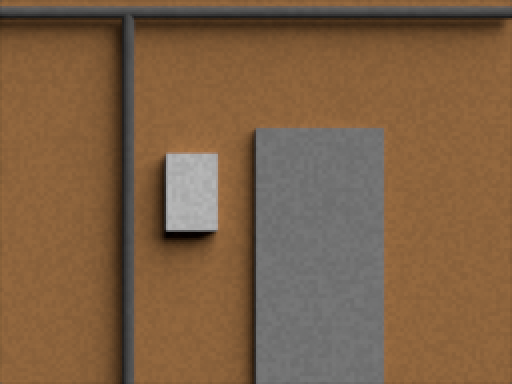
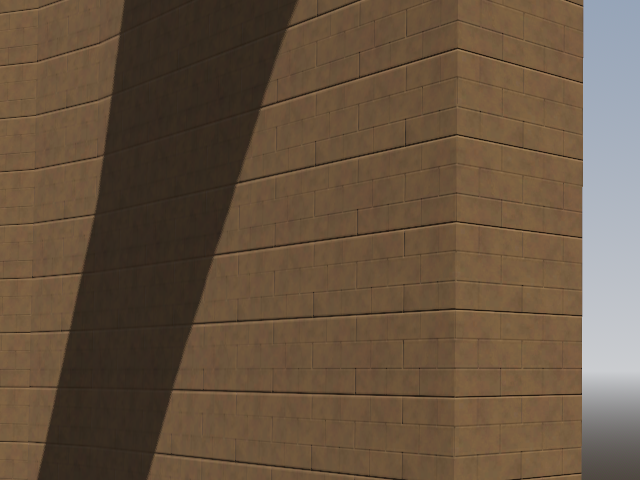
Wall cracks, 128×128 pixels and 64×64 pixels.

Blood splats in red, green, and yellow, 64×64 pixels and 32×32 pixels.

Some decals for cracks in walls and blood on the ground.

It ain’t much, but I made it. All by myself.

I’m a real Game Developer now!

I originally started learning Blender probably over a year ago, but never finished the snowman. I tried getting back on that horse last winter, but only made it through repeating the introduction to the UI and the basic tools to deform a cube over two days. But this week I got once again interested in texture painting rather than 3D modeling, and though I couldn’t find any good introduction or explanations for the kind of things I want to do specifically, enough little pieces of understanding some basic concepts fell out of the tiresome process that I thought I actually do already have all the pieces to at least get a rough model thrown together that I could do some painting practice on.

My plan was to see what I can accomplish with what I already know and only looking up what menu items or shortcuts I need to select to get the tools I already understood in 12 hours. There was a lot of trial and error throughout the morning, but after six hours I had this model finished, and never having done anything with texture painting before, I got this completed after only 9 hours.

And I think for the purposes of making assets for a game with the graphics style of Quake and Metal Gear Solid, this is already perfectly serviceable. There’s actually way too many polygons on this model.

I’m feeling really good about this. If this is any indication, I think with some practice it should be quite possible to eventually create a mid-scope asset like this with the right level of detail for Iridium Moons in two or maybe three hours. Making one after work and a couple on the weekends, and that would add up to quite a lot over a year.

Who are you? And what do you do?

Since I first started getting the idea in my head to create a fantastical world and stories of adventures that I could share with a wider audience beyond the pen and paper RPGs that I was running, the one biggest thing that I have been struggling with the most for the entire 13 years was to figure out what kind of people the protagonists would be, and what kind of things they would be doing that keeps pulling them into the kinds of adventures that are meaningful to me. Even back then I had already gotten bored with the fantasy of being a one man army who ends up with a kill count of 300 enemy soldiers and 400 monsters, who is doing all of this to become a hero and gain riches. When put like that, and I believe it is accurate for most adventure fiction and especially dungeon crawling fantasy, it actually sounds really fucked up. Could you imagine being a 20-something who has stabbed hundreds of people dead or incinerated them in magical fire, and who has been impaled by spears dozens of times and still remain a remotely sane person?

I think violence is an incredibly compelling topic. I believe it’s an integral part of human nature and something that can frighten, disgust, excite, and attract us at the same time. And how we can make sense of these conflicting instincts that are contradicting all the values we believe in and deal with them is an endlessly fascinating topic to explore. But the vast majority of adventure fiction does not explore any of this at all and simply revels in the spectacle of carnage, or actively glamorizes and revels in it. Which is something that has bothered me with much of the fiction I’ve read, watched, and played, and I find more than a bit disturbing. I always knew that the generic adventure plots of “kill the enemies, take the treasures, save the day” wouldn’t do it for me. But how else do you get a character who ends up climbing down into dangerous caves and wrecks, faces fantastic monsters, evades deadly traps, and discovers magical wonders, and then just keeps doing that again and again?

The concept I had for Iridium Moons for the last half year or so was that of playing as a salvager. Someone who goes to ruined factories, abandoned mines, or wrecked ships to find valuable spare parts that haven’t been manufactured for generations but are now incredibly valuable for people desperate to keep ancient and irreplaceable machines running. This would support gameplay in which you mostly explore the wilderness, navigate through ruins, fix broken doors and machinery to get access to other areas, and mostly try to avoid enemies and escape with your life. Which I think is a very solid idea, that should work just as well of having the game protagonist be a thief or a lunatic who thinks killing monsters is a good way to make a living. You can absolutely make an entire game about that. But it is also rather limiting in what kind of stories you can tell with it in a game that is not only an endless gameplay loop like a Rogue-like or Survival/Crafting game, but also explores the characters and society of its world.

I have considered scrapping this idea entirely and instead coming up with a completely new concept to turn the world of Iridium Moons into a game for the last weeks. But I think all the gameplay ideas I had planned could actually still make a fantastic game by simply expanding the archetype of who the players’ characters are and what they do? Instead of being specifically salvagers who make a living following leads to find old machine parts, I am now envisioning a broader concept of playing as a more generic “scout”.

The idea I have in mind for the game is not so much an explorer, surveyor, and prospector who is the first to set foot on a new planet and discover if it has any value for companies or colonists, as the term is often used in pen and paper Space RPGs. But rather someone who has the skills and the equipment to find things that have been lost in the wilderness. In many popular space adventure settings, this probably wouldn’t feel like an established or very adventurous profession, as the established technologies for reaching locations and detecting things are often highly effective and ubiquitous, making the part about finding things something that is largely glossed over as it is assumed to be not much of a challenge to spend time on. But the worldbuilding for Iridium Moons that I’ve already done over the last year may actually make it uniquely well suited as a setting for such adventures and gameplay. Detection technology is no better than what we have access to today, and the planets of the Galia Cluster have very small populations that are highly decentralized and dispersed. Many smaller communities don’t have the means to search huge areas of wilderness and won’t be getting any support from the big cities that do. And with the fierce rivalry and constant infighting among the Oligarchs, and the ruthless power struggles among their underlings, there are plenty of reasons not to make use of the official search teams.

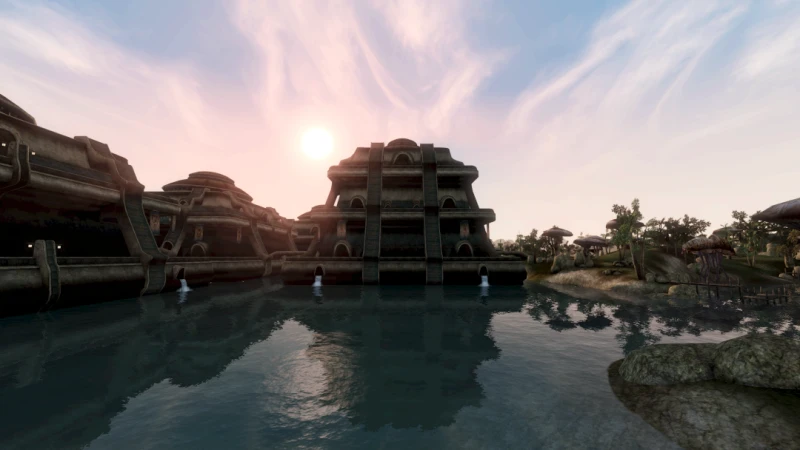
I am a huge fan of wandering around in Morrowind, Skyrim, Stalker, and Metro Exodus, exploring the environments, looking for paths to get past obstacles, and searching for hidden things. But once I find things, I am generally really not a fan of fighting through dozens of enemies that occupy a ruin, or constantly managing my inventory to figure out what things to take back with me and what to leave behind. And especially not collecting piles of dozens of different resources, which I then can turn into some junk, which unlocks other junk on the tech tree for which I have to go back and collect more resources to build. Which is why survival crafting games generally don’t work for me. I would much rather have a game, and make a game, which is just about the wandering around and exploring part, but with most of the combat gameplay instead being interesting stealth gameplay, and without having to haul around a lot of stuff that requires constant inventory management. Playing a character who gets paid to find things that are in an unknown location, instead of a character who’s objective is to collect things, could be a concept that could make this work as engaging gameplay.

Working as an independent scout provides plenty of different types jobs that players could take on:

  • Find missing people.
  • Find escaped fugitives.
  • Find bandit hideouts.
  • Find missing ships.
  • Recover lost cargo.
  • Retrieve someone else’s cargo.
  • Deliver secret cargo.
  • Locate abandoned equipment for salvage.
  • Investigate unknown signals or anomalies.

I see a lot of potential in these for the kinds of stories that I am personally interested in, involving the kind of characters that I find compelling. And make for wonderful reasons to travel through vast landscapes in an airship, on a hoverbike, and on foot as the search is closing in on the target, which lets players take in the sights and sounds without being hurried along by action while still investigating the world for clues and planning out their next steps as they are moving, making it more than just idle time that makes you consider using fast travel.

I am feeling quite good about this, and more optimistic than all the other ideas I’ve been exploring before.