
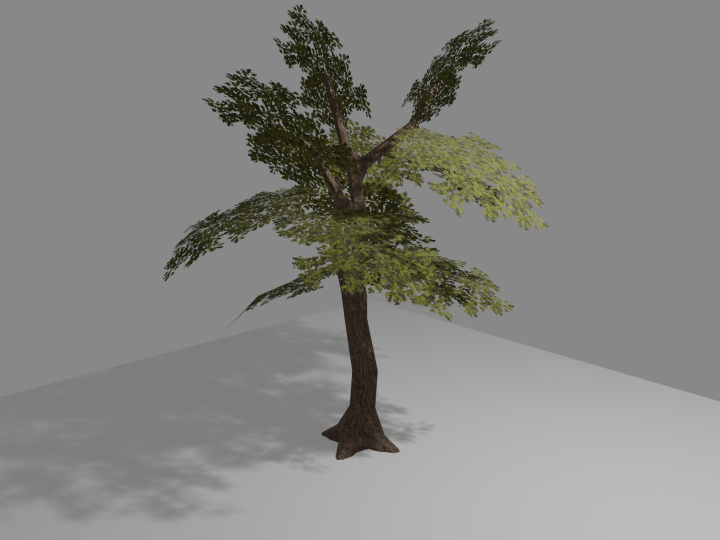
This tree might not look like much by itself, but this marks one of the biggest milestones in my development as a game creator.
For the last three months I’ve mostly been busy working out non hobby stuff, but when I’ve been coming back to work on the game on and off, developing an art style and figuring out the techniques to produce plants for Iridium Moons has been the main focus of all my efforts.
And I am very happy that today everything has come together, exactly the way I wanted. I now have one first tree that I will happily have appear in the finished game.
Back in spring, I found that the way in which I approached making environment assets in Blender would basically let me make things in the visual style of early 2000s games like Morrowind and Knights of the Old Republic just as fast as the mid-90s style of Quake or Tomb Raider, and followed that direction for a while. But with some more time to reflect on it, it would absolutely be doable for me and looks very nice, but I just don’t find it nearly as inspiring or interesting to work on. The blockiness of low-polygon models and graininess of unfiltered textures of this art style has a very important impact on the overall aesthetics of the games that use it, and is an art form that uses abstraction and reduced fidelity as a key tool, like impressionist painting, black and white photography, or claymation. It’s a visual style that was created in response to very severe technical limitations. But the way that artists found ways to get something at least passably interesting and inspiring on screen under these limitations resulted in a new form of artistic expression that remains interesting and inspiring even after it’s no longer a technological necessity. And for that it has become an art movement in itself, that has seen a huge resurgence in the last 8 years. (For which I entirely credit David Szymanski’s Dusk.)
Iridium Moons is directly based on several movies from the 80s and 70s, which themselves had been references to even earlier works, many of which are depicting very anachronistic worlds. So even besides the inherent artistic qualities of the Raw 3D graphics of id Tech 2 and the PlayStation, going with a decades old graphics style from before the major revolution that created modern 3D graphics in the mid-2000s is just a very appropriate fit. An Iridium Moon game made in the Build Engine with character sprites instead of 3D models would also work. Or even RPG maker with an SNES aesthetic. But pixel art sprites have always confused and intimidated me, so the Raw 3D look with simple wireframe models is the way that feels most practical to me.
Going from my earlier tree models, that were coming along quite nicely, to something that would look fitting for a PS1 game turned out to be surprisingly more complicated than I thought. If you simply lower the fidelity by reducing the number of polygons and decreasing the number of pixels, you soon get to a point where the details of a realistic plant simply disappear. Just as with low-resolution 2D sprites, you have to approach the model and textures differently. Instead of creating a realistic tree at very low resolution, you need to construct something that evokes the idea of a tree in the observer’s brain. It doesn’t even have to look like an actual tree. It needs to have traits that the brain interprets as a tree. You need to stop trying to depict reality. And instead create an object that manifests the traits of the actual thing that matter to the brain.
We recognize bark by the patterns in the variation of colors caused by pigments and the way light interacts with uneven surfaces. We recognize branches by the way that they fork and get thinner towards the end. We recognize a mass of millions of leaves as being leaves by the patterns of leaves being lit by sunlight or being in the shadows of other leaves, as well as being able to see the background behind the tree peaking through in some spots. These patterns are what a very low fidelity model needs. Even when the scale is 10 or 20 times off for what would be found on a real tree of its size, the color patterns and shapes are still enough for the brain to tell itself that it is seeing a tree.
The tree model I made only has three branches. The leaves are only 12 flat planes with a mottled green pattern full of holes. Real trees look nothing like this. This is an anatomical abomination. But it works as a tree because it checks all the boxes that our brain is looking for, while at the same time being so far from reality that it doesn’t trigger the instinctive reaction that something is not quite right with it.
Cartoonists and pixel art makers probably understand all of this, as they are facing the same issue of not having the fidelity to depict important fine details. But this has been a very interesting learning experience for me. I started out spending days looking for the right textures for what I wanted and never coming up with anything. And tried out so many plugins and extensions to generate realistic plants that I could scale down. But it never looked good. And in the end, I did everything on this tree with placing individual vertices in Blender and using lots of copies of a heavily scaled image of a branch with 30 leaves. The end result comes out at 616 triangles and 43 kb of texture files. And it looks perfect.
The most interesting discovery in all of this is that this style of tree actually never existed. Certainly not in the 90s or 2000s, and I think not even at all until I made it. I thought I had seen trees in this style everywhere in dozens of games, but checking back on all the games I thought might have them, none of them do. They all do have two billboards of a tree photo stuck into each other so you can look at it from any side. The only place where I was able to find anything similar to this style, and where I probably got the idea from, is in Morrowind. Which has always been using much larger texture files and texture filtering and only came out in 2002.
These trees are a figment of my imagination. The first thing I encountered that seems to be the full on Mandela Effect. But for something that images a game from the 90s that never was, which is adapting a movie from the 80s that never was either, this seems like a perfect fit.